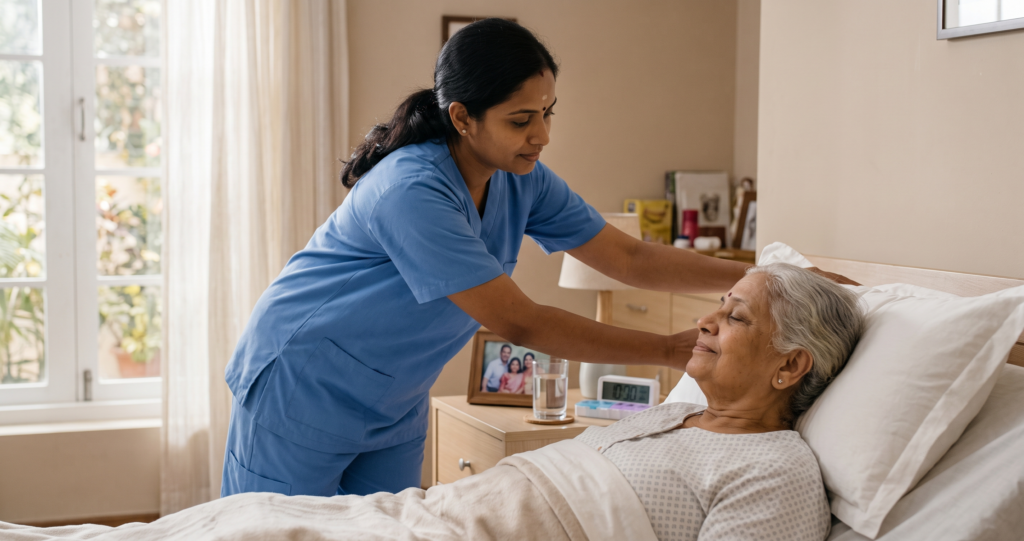

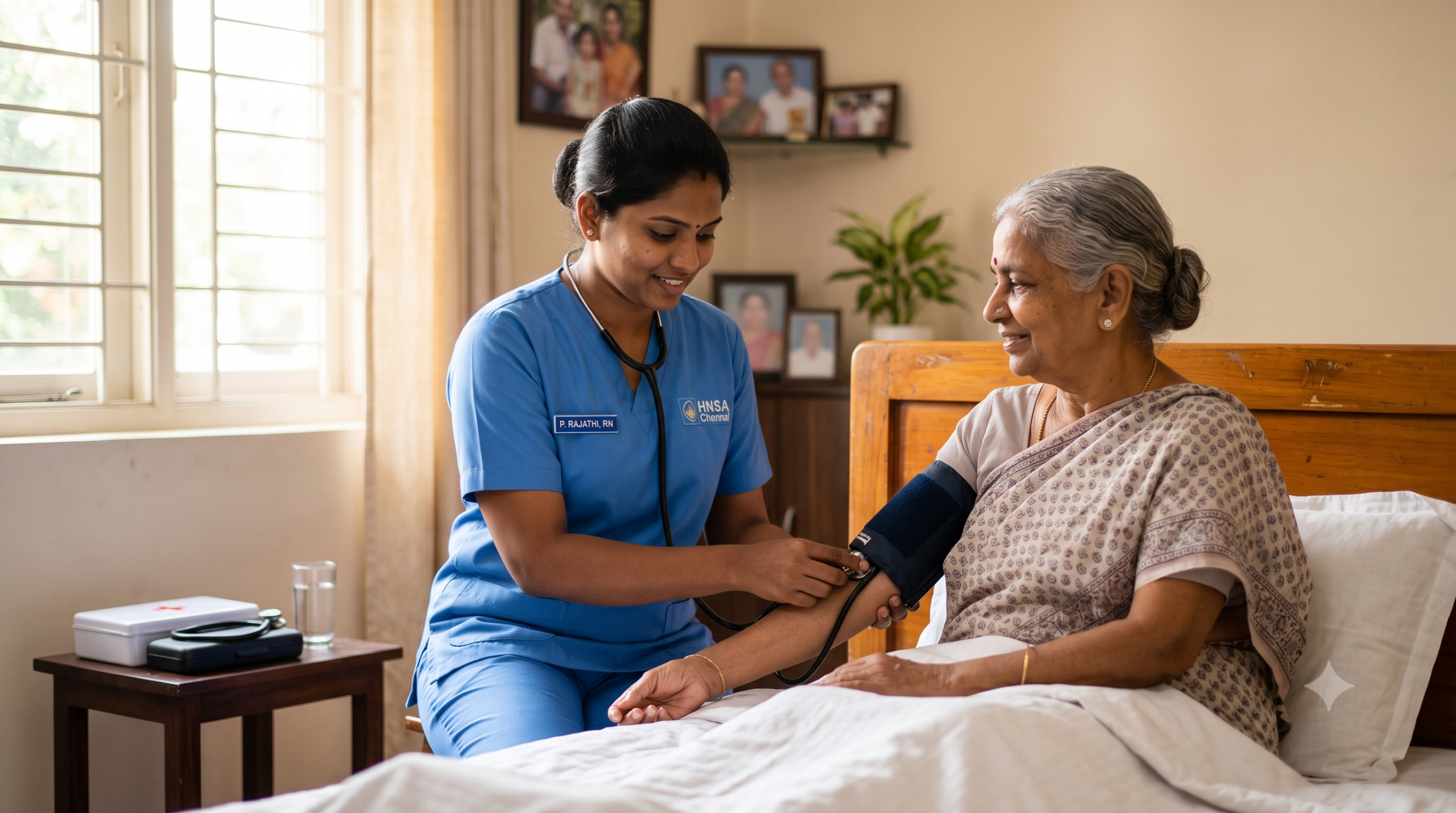
After a hospital discharge, doctors often prescribe ongoing care, injections, dressing changes, monitoring, that still needs a trained professional, just not necessarily a hospital bed. That’s the specific gap home nursing fills, and it’s easy to confuse with general patient attendant support, which is a different role entirely.
This guide explains what home nursing actually involves, how it differs from a patient attendant, and what to check before bringing a nurse into the home.
Quick Answers
What does a home nurse actually do?
A home nurse carries out medical procedures a doctor has specifically prescribed, such as injections, IV drips, wound dressing, and monitoring vital signs, at the patient’s home.
What’s the difference between a home nurse and a patient attendant?
A home nurse is a formally qualified professional (ANM, GNM, or B.Sc Nursing) who can perform medical procedures. A patient attendant provides daily physical care and comfort but doesn’t perform medical procedures.
Do I need a doctor’s prescription for home nursing services?
Generally, yes. A home nurse works from a doctor’s specific instructions rather than diagnosing or prescribing treatment independently.
What nursing qualifications should a home nurse have?
Look for a recognized qualification such as ANM, GNM, or B.Sc Nursing, ideally with experience relevant to the specific medical need.
What Is Home Nursing?
Home nursing is medical care provided at home by a qualified, registered nurse, carrying out procedures a doctor has specifically prescribed. It’s different from general daily care support, home nursing specifically covers the medical side of recovery, performed by someone trained and qualified to do it.
What Home Nursing Typically Includes
- Administering injections, as prescribed by the treating doctor
- IV drips and fluid administration, where medically indicated
- Wound dressing and post-surgical care, following the doctor’s care plan
- Catheter care, for patients who need it
- Monitoring vital signs, such as blood pressure, pulse, and temperature, and flagging changes to the doctor
- Medication administration, per the doctor’s prescription
Understanding Nursing Qualifications: ANM, GNM, and B.Sc Nursing
- ANM (Auxiliary Nurse Midwife), a foundational nursing qualification, typically a two-year diploma
- GNM (General Nursing and Midwifery), a more comprehensive three-year diploma qualification
- B.Sc Nursing, a four-year bachelor’s degree, the most extensive academic qualification of the three
All three are recognized nursing qualifications in India, registered through state nursing councils under the Indian Nursing Council. Which one fits best depends on the complexity of the medical care actually needed.
Home Nurse vs Patient Attendant
| Factor | Home Nurse (ANM / GNM / B.Sc) | Patient Attendant |
|---|---|---|
| Qualification | Formal nursing diploma or degree | General caregiving experience, no nursing degree required |
| Scope of work | Doctor-prescribed medical procedures | Daily physical care and comfort |
| Examples | Injections, IV drips, wound dressing, vitals monitoring | Repositioning, feeding assistance, hygiene support |
| Best fit | Anyone needing prescribed medical care at home | Anyone needing daily physical care support |
Many families use both together: a nurse for scheduled medical procedures, and an attendant for round-the-clock daily care in between visits.
When Home Nursing Is Needed
- Post-surgical recovery requiring wound care or dressing changes
- Chronic illness management requiring regular injections or monitoring
- Transitioning home after hospitalization, continuing care the hospital started
- Elderly patients with health conditions needing regular vitals monitoring
Do You Need a Doctor’s Prescription?
Generally, yes. Home nursing extends and supports a doctor’s existing care plan at home, it doesn’t replace the doctor. A home nurse carries out what’s been prescribed and reports back on the patient’s condition, rather than making independent diagnostic or treatment decisions.
What to Check Before Hiring a Home Nurse in Chennai
- Verified nursing qualification (ANM, GNM, or B.Sc) and registration
- Relevant experience with the specific medical need, such as wound care or post-surgical recovery
- Clear communication with the treating doctor about the care plan
- Availability, whether shift-based visits or round-the-clock presence is needed
- Background verification of the nurse as an individual entering the home
- A replacement policy, in case the arrangement isn’t the right fit
Vallalar Home Care Services provides qualified ANM, GNM, and B.Sc trained home nurses across Chennai, verified through Aadhaar-linked biometric checks, address verification, and police clearance before placement. Where daily physical care is also needed alongside medical procedures, the team can arrange a patient attendant to work alongside the nurse, with a replacement arranged within 24 to 48 hours if either arrangement isn’t the right fit.
Final Thoughts
Home nursing exists precisely for the situations where hospital-level care isn’t necessary, but qualified medical attention still is. Knowing the difference between a nurse’s role and an attendant’s role makes it much easier to arrange exactly the right kind of support after a diagnosis, surgery, or hospital discharge.
Need a qualified home nurse in Chennai? Reach out to Vallalar Home Care Services to discuss your family’s medical care needs.
Frequently Asked Questions
What does a home nurse actually do?
A home nurse carries out medical procedures specifically prescribed by a doctor, such as injections, IV drips, wound dressing, and monitoring of vital signs, at the patient’s home.
What’s the difference between a home nurse and a patient attendant?
A home nurse holds a formal nursing qualification and can perform medical procedures. A patient attendant provides daily physical care and comfort but is not qualified to perform medical procedures.
Do I need a doctor’s prescription for home nursing services?
Generally yes, home nursing care is based on a doctor’s specific instructions rather than the nurse independently deciding on treatment.
What do ANM, GNM, and B.Sc nursing qualifications mean?
They are recognized nursing qualifications in India of increasing depth: ANM is a foundational two-year diploma, GNM a three-year diploma, and B.Sc Nursing a four-year degree.
Can a home nurse and a patient attendant work together?
Yes, this is a common arrangement, a nurse handles scheduled medical procedures while an attendant provides daily physical care in between.
How quickly can a home nurse be arranged?
This depends on the provider and specific requirement, but an established local agency can often arrange a qualified nurse fairly quickly for standard cases.
Related Reading
- Professional Home Nursing Services
- Bedridden Patient Caretaker Services
- About Vallalar Home Care Services
- Family Reviews
- Contact Us